Bopwire — Technical White Paper
A peer-to-peer music network where the listeners are the infrastructure, content is verified by cryptographic fingerprint, and every play settles on a purpose-built blockchain. This is a technical description of how the system works. It is not financial advice and makes no claim about the monetary value of any token; the token is described purely as the network's internal accounting and reward unit.
Contents
- The problem
- The core idea
- Network topology (who talks to whom)
- Anatomy of a play (how data propagates, end-to-end)
- Content identity — fingerprinting & canonical hashes
- The transfer layer — multi-source swarm with verified pieces
- The discovery layer — a private DHT
- The relay layer — NAT traversal as a paid role
- The chain — blocks, proofs, and the play lifecycle
- Economics — the five reward lanes, supply, and burn
- Wallets, transfers, and non-custodial escrow
- Security model
- Governance & moderation
- Decentralization posture
1. The problems
The subscription model is a poor economic model for media distribution and consumption.
When Napster, Spotify and other technolgies were created, cryptocurrency did not exist.
When you charge a subscription for an all you can eat buffet, royalties etc aren't as good as charging $20 for a physical copy. They can't be. One million artists at a subscription fee of less than $20 practically robs artists anyway since that subscription fee divided by those million artists is $0.00002. So, they also HAVE to do independent artists dirty, their royalties are going to Taylor Swift instead.
Bopwire re-arranges that stack so the people listening also supply the delivery network, the payment is settled per play on a public ledger, and no single company owns the pipe.
In our research of cryptocurrencies with similar supply caps, even the small cap coins can fetch $0.10 on the market. Even with .01 cents, the platform pays as much or more as Apple PER STREAM SERVED. The general idea would be for the majority of music players to use this kind of technology, so that every play is accounted for and paid for.
In addition, independent artists today practically have to pay to get heard. There is a lot of debt in the sense of new music and listeners, and there's so much of it that it has become spam to the listener.
To combat this problem, Bopwire pays the listener for plays under 10,000. We have asked this question: Should someone who discovers something great and plays it a lot be paid to organize the quality? We beleive the answer is actually yes, but artists shouldn't have to pay for those listens.
2. The core idea
Three mechanisms are wired into one loop:
- Listeners are the CDN. When you have a song, your device seeds it to
other listeners — like BitTorrent. Bandwidth scales with the audience instead of with a server bill.
- Everyone who did work gets paid per play, on-chain. Not just the artist —
the peer that uploaded the bytes (the seeder) and the relay that carried them are each credited a token every time a song is genuinely listened to. Those that put in work to listen to new and undiscovered music also get paid.
- Content is identified by what it sounds like. An audio fingerprint collapses every upload of the same song into one canonical entry, so the swarm pools all copies and the royalty always lands on one artist — regardless of who uploaded which file.
- Transport is librats, a custom C++ peer-to-peer library.
- Identity is unified: one key is your network identity and your wallet.
- Mini-nodes exist because most listeners are behind NAT and can't accept inbound
- ① Discover. The listener asks the full node who has this content_hash. The
- ② Fetch. The listener requests a range of pieces with
swarm.fetch. The - ③ Account. Independently, the player opens a session with the full node,
- ④ Settle. The node checks the play is genuine (§9), signs a PlayProof, and
- Every song carries two hashes: a
content_hash(SHA-256 of the exact audio - On ingest the player computes both and submits via
fingerprint.submit. The full - The canonical entry lives in a block's
SongSection(artist address, royalty - Pieces: 256 KB. Ranges: a
swarm.fetch{piece_start,count}pulls up to 16 - Manifest: generated at ingest —
sha256of each piece — and served by the - Wire format: binary, not base64 — pieces stream as
F-frames - Flow control: each seeder paces its own upload to a 4 Mbit/s per-stream
- The DHT speaks the standard Kademlia/KRPC wire format **but every packet carries a
- A seeder's bytes flow
seeder → mini-node → downloader. The relay forwards opaque - The relay is also a deliberate economic anchor: routing the data path through a
- Coverage gate: the union of distinct position ranges actually heard must
- Density gate: heartbeats must arrive at a plausible rate (≥1 per ~10s of wall
- Replay protection: each
session_idis single-use, persisted on-chain; a - Transactions:
TRANSFER,MINT(the play reward),RELAY_REWARD(legacy), PlayProofis versioned by length for forward-compatibility: legacy proofs- The chain is currently produced/validated by a single full node (a permissioned
- Precision:
1 token = 1e8internal units (like satoshis). Each lane is exactly - Royalty splits: the artist lane is divided by on-chain basis-points among
- Supply control.
SUPPLY_FLOOR = 1,000,000,000tokens and `SUPPLY_CAP = - The mini-node lane is per-stream, not per-byte.
- Transfers are
TransferTx{from, to, amount, nonce, from_pubkey, signature}. - Escrow is non-custodial. A pre-threshold artist reward is minted to a
- A three-tier role model on-chain:
FOUNDER(bootstrap authority, can grant/revoke - Takedown without cutting the artist: a "hidden" track is delisted from
- The shape is a maintainer hierarchy (think Linux/BDFL): a steward over an open
- Decentralized: content distribution (the swarm), discovery (private DHT +
- Centralized by necessity: identity verification and escrow release, and
- Stewardship: development and root authority currently rest with a founder
The result is a self-bootstrapping delivery network where the users are the infrastructure and are compensated for it, settled on a ledger no one privately controls.
3. Network topology (who talks to whom)
Four roles exist. A single device can play several of them at once (a phone is a listener, a seeder, and a wallet simultaneously).
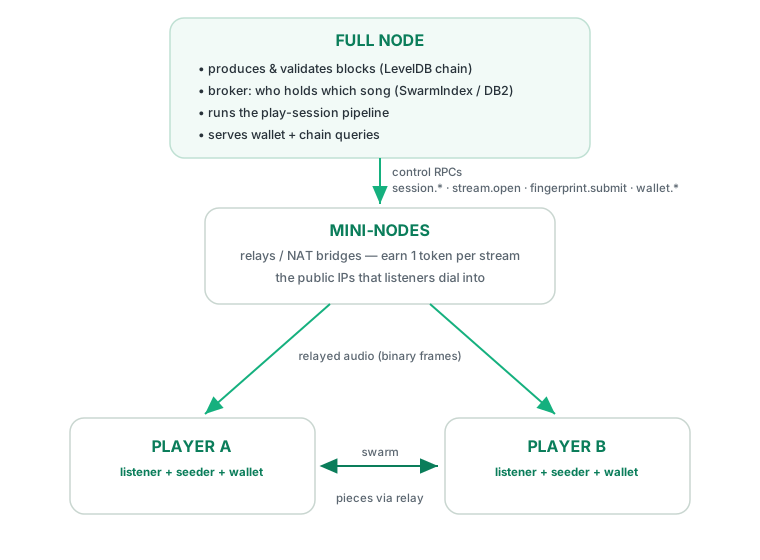
In plain terms. Listeners (players) don't usually connect to each other directly — they connect to mini-nodes, which are relays sitting on reachable public IP addresses. The mini-node passes audio between two listeners (one seeding, one downloading). The full node is the bookkeeper and rule-keeper: it knows who holds what, runs the rules that decide a "real" play, and writes the blockchain.
Under the hood.
connections. It's also a deliberate economic choice (see §8).
4. Anatomy of a play (how data propagates, end-to-end)
This is the central data-flow. Follow a single song from "tap play" to "everyone paid."
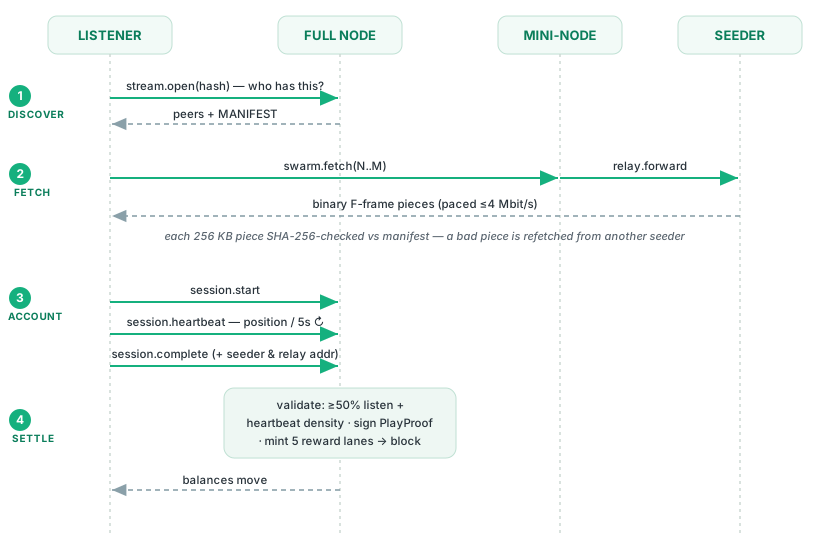
Step by step.
node answers with a list of online peers that hold it plus the song's piece manifest (the list of per-piece checksums — see §6). One round-trip; the manifest means the listener already knows the file's exact size and shape.
request travels to a seeder through a mini-node (relay.forward); the seeder streams the bytes back as binary frames through the same relay. The seeder paces itself to ≤4 Mbit/s per stream. The listener verifies each 256 KB piece against the manifest's SHA-256 as it arrives; a corrupt or lying piece fails its hash and is refetched from a different seeder.
sends a position heartbeat every 5 seconds while actually playing, and on finish reports session.complete — including the addresses of the seeder and relay that served this play.
mints the five reward lanes into the next block. Balances update.
Why two parallel tracks? The audio path (①②) and the accounting path (③④) are deliberately decoupled. Audio flows peer-to-peer through relays; payment flows through the full node's session pipeline. They meet only at the end, when the session reports who served the bytes.
5. Content identity — fingerprinting & canonical hashes
In plain terms. Two people can upload "the same song" as different files (different bitrate, different encoder, a re-rip). Bopwire recognizes them as the same song by listening to them, not by comparing file bytes. That way the swarm pools every copy together and the artist earns no matter which copy played.
Under the hood.
bytes — addresses this file) and a fingerprint_hash (SHA-256 of a compressed Chromaprint acoustic fingerprint — addresses this recording).
node matches against the chain three ways: exact fingerprint_hash, exact content_hash, then a fuzzy Chromaprint similarity search (bucketed index, similarity ≥ threshold) so different encodings of one recording canonicalize to a single on-chain song entry.
splits, metadata, duration). Variants register against it instead of duplicating.
6. The transfer layer — multi-source swarm with verified pieces
This is "Swarm Transfer v2," the layer that actually moves the audio.
In plain terms. A song is cut into fixed 256 KB pieces. A download can pull different pieces from several seeders at once, so your speed is the sum of their upload speeds, not any one peer's. Every piece arrives with a checksum the uploader can't fake, so pulling from strangers is safe — a bad piece is detected instantly and refetched elsewhere.
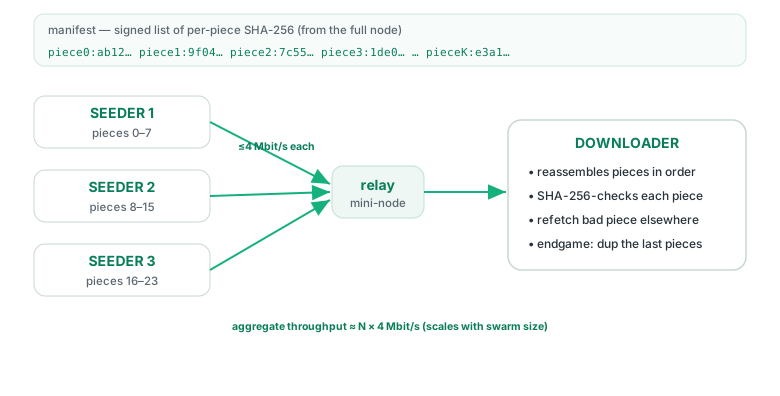
Under the hood.
pieces (4 MB) per request, so one round-trip amortizes over many pieces.
full node alongside the peer list. Per-piece verification is what makes untrusted multi-source safe: a bad piece fails its own hash (you know which one) instead of only discovering corruption after assembling the whole file. The whole-file content_hash is the final backstop.
[stream_id | seq | eof | payload] through the relay's binary channel (~33% less overhead than a JSON/base64 reply).
cap; a downloader opens one flow per seeder (a process-global per-seeder window) and aggregates across many — so total speed scales with swarm size while no single seeder is overloaded. Streaming biases to the next-needed pieces from the fastest seeders; bulk download fans wide. An endgame mode duplicate-fetches the final pieces so one slow seeder can't stall completion.
7. The discovery layer — a private DHT
In plain terms. Beyond asking the full node "who has this song," peers also keep a distributed phone-book (a DHT) so discovery survives even if a node is busy. The important property: this phone-book is private — it only talks to other Bopwire nodes, never the public BitTorrent network.
Under the hood.
private network tag** (a top-level "mc":"mcnet1" key). Any inbound packet missing the tag is dropped at decode, so the public BitTorrent mainline can never enter the routing table and Bopwire nodes never answer it.
8. The relay layer — NAT traversal as a paid role
In plain terms. Most phones and home machines can't accept incoming connections (they're behind NAT/firewalls). The mini-node is a relay on a reachable address that bridges two such peers. Crucially, relaying is a paid job — a mini-node earns a token every time it carries a stream or download — so there's an incentive to run the infrastructure that keeps the network reachable.
Under the hood.
F-frames (relay.forward for control, relay-bin for audio) and is content-agnostic — it doesn't parse the audio, it just bridges.
paid relay is what funds the reachable-IP layer. (Direct peer connections + ICE hole-punching exist in the stack but are off by default.)
9. The chain — blocks, proofs, and the play lifecycle
In plain terms. The blockchain is the shared, tamper-evident record of what was played and who got paid. A play only becomes money if it passes anti-cheat rules — you can't loop a 5-second clip or fake 10,000 plays to print tokens.
The session lifecycle. A play is a three-message conversation with the full node:
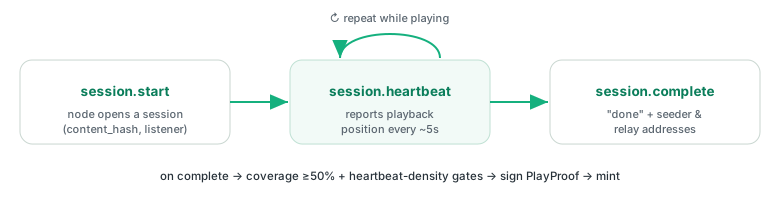
The anti-cheat gates (run at session.complete).
cover ≥50% of the song's registered duration. Re-listening the same 5 seconds collapses to 5 seconds of coverage — you can't loop a clip to qualify.
time), so you can't fast-forward and "complete" instantly.
reused session is rejected.
The proof. A passing play produces a signed PlayProof — session id, content hash, block hash, artist, listener, serving-node id, timestamps, duration, heartbeat count, and (v2) the seeder and mini-node addresses — signed by the full node's key. The node embeds it in a MintTx with the computed reward outputs and applies it to the next block.
Under the hood.
MODERATOR_OP, MODERATOR_PROPOSAL, USERNAME_REGISTER, SLASH. State is LevelDB; pending txs sit in a mempool and a candidate-block builder drains them.
deserialize without the seeder/mini fields and keep validating, so adding the new reward lanes required no chain reset.
validator); light-client players don't validate blocks, they trust the node's signed results. Multi-validator consensus is a forward step (see §14).
10. Economics — the five reward lanes, supply, and burn
In plain terms. Every genuine play mints tokens to everyone who made it happen — not just the artist. The token is the network's internal unit of account and reward; it is consumed and earned by participation.
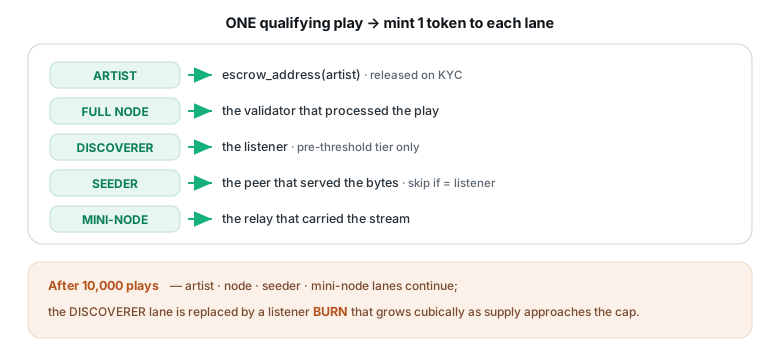
Listening to popular artists spends tokens, and those tokens are burned at a variable rate — taken out of circulation for good. What survives the burn flows the other way: to the artists who made the thing and the seeders who keep it alive on the network. So the economy runs as a loop, not a pump — value is drawn in at one end by attention and paid out at the other to the people doing the actual work, with the burn sitting in between as the throttle.
We have put some cybernetics ideas into this as well. When the network runs hot — more plays, more transfers — more is burned, and supply tightens against its own activity; when it runs cool, the pressure eases. There's no hand on the dial and no central bank. So here, the burn is the governor: a negative feedback loop that holds the token near equilibrium the way a steam engine's governor holds its speed. The upshot is that the currency can't inflate itself into noise — the more it's used, the more disciplined it becomes, and value keeps settling on the parts of the system that create and sustain rather than the parts that merely consume.
To quote Stafford Beer:
"According to the science of cybernetics, which deals with the topic of control in every kind of system (mechanical, electronic, biological, human, economic, and so on), there is a natural law that governs the capacity of a control system to work. It says that the control must be capable of generating as much 'variety' as the situation to be controlled."
In that sense, the burn is built in accordance with Ashby's Law (which is what Beer is referencing here) — the requisite (negative-feedback) variety matched to the state of the system that would otherwise inflate.
Under the hood.
1.00000000.
collaborators/labels (validated to sum ≤ 100%; any remainder routes to an unclaimed escrow).
2,000,000,000`. Below the floor there is no burn ("give the network away" bootstrap). Between floor and cap a per-play listener burn scales cubically — roughly: 1.0 B supply ⇒ 0 burned, 1.5 B ⇒ ~125, 1.8 B ⇒ ~512 — so usage gets deflationary pressure as the chain approaches the cap, and minting refuses past it.
11. Wallets, transfers, and non-custodial escrow
In plain terms. Your wallet is a key on your device. Sending tokens is a message you sign — the network never moves your money without your signature, and the nodes never hold your private key. Artists' pending earnings sit in escrow held by the blockchain itself, not by any operator's wallet.
Under the hood.
The signer covers chain_id | from | to | amount | nonce | from_pubkey with secp256k1; the chain verifies the signature, cross-checks address_from_pubkey == from, enforces a per-sender nonce (replay protection), and checks balance. The private key never leaves the device; a node only validates and relays a signed transaction (the eth_sendRawTransaction model). MC_CHAIN_ID = 19779 is mixed into the signature so it can't replay on another chain.
deterministic escrow_address(artist) — funds the chain holds, not an operator. Release is a RELEASE_ESCROW proposal approved by a moderator quorum (majority vote), and it can only pay out to the artist the escrow was created for. No single party custodies the funds; a signer cannot divert them to themselves. The trusted part is identity verification (is this really the artist), not custody — a narrower role than holding a pot of money.
12. Security model
| Surface | Mechanism |
|---|---|
| Value transfer | secp256k1 signature + inline pubkey cross-checked to from address + per-sender nonce (anti-replay). |
| Play minting | Node-signed PlayProof; single-use session_id; 50% coverage + heartbeat-density gates. |
| Piece integrity | Per-256 KB SHA-256 manifest verified on arrival; whole-file content_hash backstop. |
| Network isolation | Private DHT tag drops all non-Bopwire packets; private bootstrap only. |
| Escrow | Funds chain-held at a deterministic address; destination-bound; quorum-released; not operator-custodied. |
| Sybil / cheating | Permissioned, vouched moderators; cubic burn past the play threshold; replay-proof session/nonce sets. |
| Identity | One secp256k1 key = peer-id = wallet address (single identity across network and ledger). |
13. Governance & moderation
In plain terms. A small, accountable set of moderators handles the things a public vote can't safely do — verifying an artist's identity to release escrow, and acting on takedown (DMCA) requests. New moderators must be vouched for, because a flood of fake moderators approving fake identity claims would be an attack.
Under the hood.
moderators), OP (proposes and votes on actions), VOICE (observer). Multi-step actions (hide content, release escrow) go through ProposalTx and execute on OP-majority quorum in-block — no single operator acts alone.
discovery but its on-chain royalty entry persists — so a DMCA-complied song can still settle the artist's earnings even while it's removed from the catalogue.
base, intended to widen its operator and moderator set as the network grows.
14. Decentralization posture
Bopwire is decentralized where it can be and centralized only where a public process would be unsafe — and it keeps those layers separate on purpose:
SwarmIndex), value transfer (self-signed transactions), and token issuance (fixed, algorithmic, minted by genuine plays — no pre-mine, no sale, no protocol fee to any central party).
content takedown. These can't be a public vote without becoming an attack surface (fake-identity approval, or a mob withholding an artist's money). This is an authorization role — the chain holds the funds; moderators only attest and can't divert — not a custodial one.
operating as a node on the same terms as any operator (no special token reward, no fee, no allocation).
The design goal is a network whose value is created by its participants and recorded on a ledger no one privately owns, with the unavoidable trust (identity, takedown) confined to a narrow, accountable, non-custodial role.